Free online quotes Get pricing in minutes
How to Protect Your Concrete Driveway from Pittsburgh Snow and Road Salt
Concrete and asphalt Repair, install, resurface
15 years in service Trusted across Pittsburgh
How to Prevent Salt Damage on Concrete
The single most effective way to protect a concrete driveway from Pittsburgh snow and road salt is to keep it properly sealed on a regular schedule and switch to a calcium-chloride-based de-icer instead of rock salt — sealing blocks the moisture that salt needs to do its damage, and a gentler de-icer avoids the chemical attack that causes surface scaling in the first place. The two work together: a sealed surface with the wrong de-icer still takes damage over time, and the right de-icer on an unsealed driveway still lets water and salt soak in.
Why Salt Is Harder on Concrete Than Snow Alone
Snow and ice by themselves aren't what damages a concrete driveway — it's the combination of moisture, freeze cycles, and de-icing salt that does the real harm. Rock salt (sodium chloride) lowers the freezing point of water, which sounds helpful, but it also means water can refreeze and re-thaw more times per season than it otherwise would, multiplying the number of freeze cycles your driveway absorbs. On top of that, salt draws moisture into the concrete's pores through a process called osmotic pressure, and the chloride ions in some de-icers chemically attack the cement paste at the surface, causing it to flake and scale even without any freezing involved.
De-Icers to Avoid — and What to Use Instead
| De-Icer | Effect on Concrete |
|---|---|
| Rock salt (sodium chloride) | Cheap and effective on ice, but the most damaging option for concrete surfaces over time |
| Calcium chloride | Works at lower temperatures than rock salt and is gentler on properly cured, sealed concrete |
| Calcium magnesium acetate (CMA) | The least corrosive option for concrete, though it costs more and works best above about 20°F |
| Sand or non-chemical traction aids | No chemical damage risk at all, though they don't melt ice — good for traction on top of a de-icer |
If you're using any chloride-based de-icer, sweeping up the residue once it's done its job — rather than letting it sit and dissolve back into the concrete on the next thaw — meaningfully reduces long-term exposure.
Sealing Is Your First Line of Defense
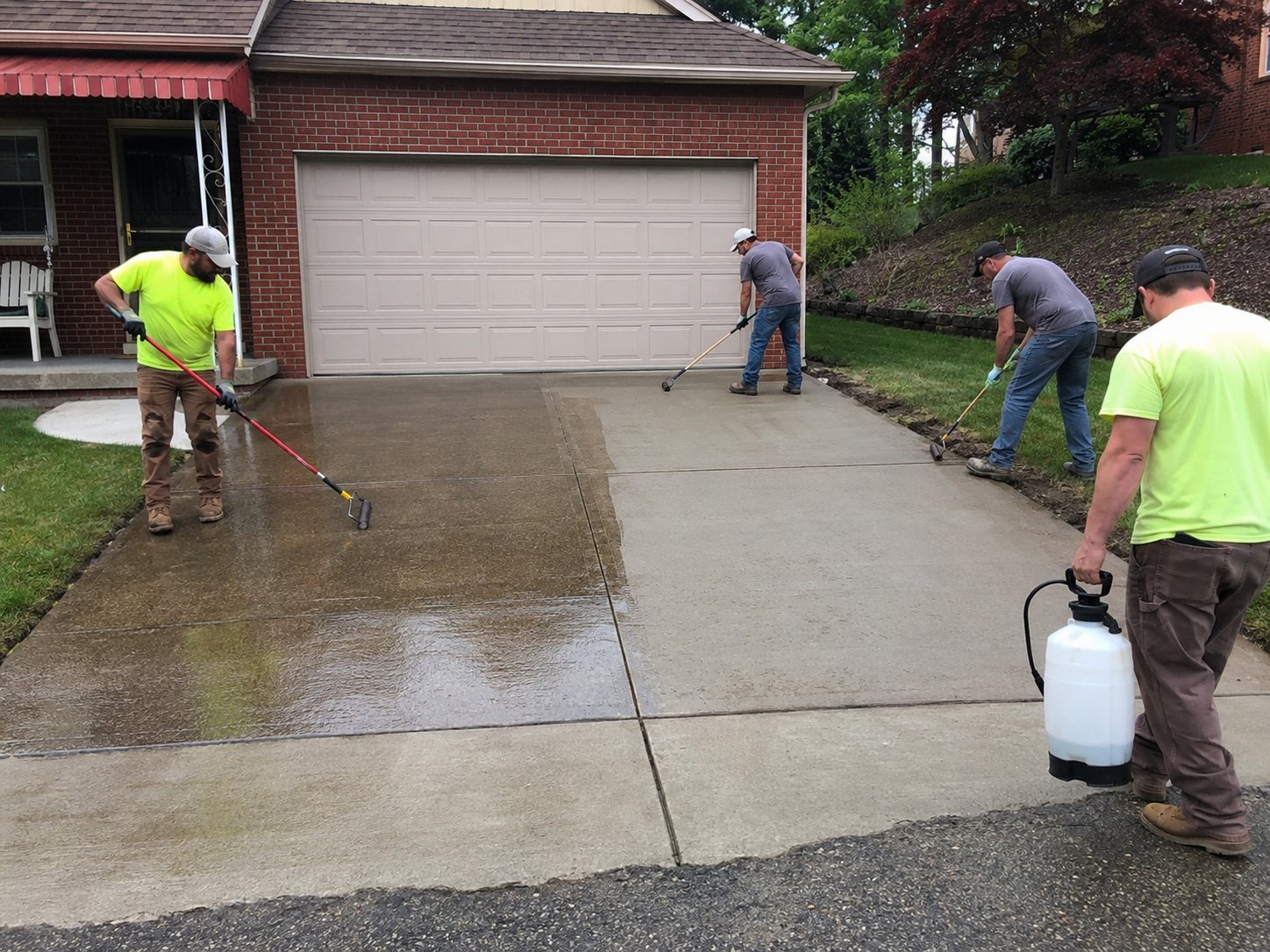
A properly applied penetrating sealer soaks into the concrete's pores and blocks water — and the salt dissolved in it — from getting in, which addresses both mechanisms of damage at once. Most Pittsburgh driveways benefit from resealing every two to three years; a driveway that's never been sealed, or hasn't been resealed in five-plus years, is far more vulnerable to both freeze damage and salt scaling than one on a regular schedule.
Snow Removal Habits That Help
Shovel or plow before packed snow turns to ice wherever possible, since a thinner ice layer needs less de-icer to clear. Avoid metal-edged shovels and plow blades scraping directly on the surface, which can chip or scratch an otherwise sound slab — a poly or rubber-edged blade is gentler on concrete. And where you can, direct meltwater away from the driveway rather than letting it pool and refreeze on the same section repeatedly.
Warning Signs Salt Damage Is Already Happening
Watch for white, chalky staining (efflorescence), a rough or flaking surface texture (scaling), small craters where pieces of the surface have popped off (spalling), or a driveway that seems to be "dusting" more each winter. Caught early, sealing usually stops these from getting worse. Left alone, they typically progress into the kind of surface damage that needs resurfacing or patch repair to fix.
Keep Your Driveway Ahead of Winter
If it's been a few winters since your driveway was last sealed, or you're already seeing early signs of salt damage, we'll take a look for free and tell you honestly whether it needs sealing now or can wait another season. Call us for a free on-site assessment before winter sets in.
Keep Exploring
Related Concrete Services & Areas
ServiceConcrete Sealer Pittsburgh
Concrete Sealer Pittsburgh – Protect, level, and restore your concrete! Expert sealing and repairs for lasting durability. Call 412 900 4557 for a free quo
Read more GuideWhy Is My Concrete Driveway Cracking Every Winter?Why concrete driveways crack every winter in Pittsburgh, what winter freeze damage looks like, and how to stop it from getting worse. Call 412 900 4557.
Read more Concrete Driveway Pittsburgh
Get Your Free Pittsburgh Concrete Quote
Written fixed-price quotes. All permits handled. 5-year workmanship warranty. Free on-site visit.